Corrosion monitoring helps engineers understand how process conditions affect equipment materials. However, different monitoring methods provide different information.
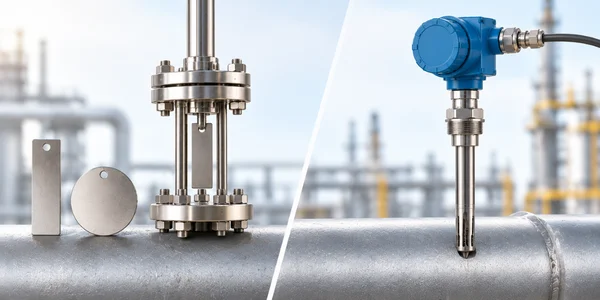
Corrosion coupons provide physical specimens for evaluating metal loss after exposure. Electronic probes allow measurements while the sensing element remains installed, helping teams follow changes during operation.
Choosing between them depends on the process environment, the information required and how quickly the team needs to identify changes. In some applications, using both provides a more useful picture than relying on either method alone.
What is the Difference Between Corrosion Coupons and Probes?
The main difference is how and when the measurement becomes available.
Coupons are recovered after a defined exposure period, prepared and evaluated. Electronic probes use instruments to collect readings during exposure, with performance depending on the measurement technique and installation.
| Factor | Corrosion Coupons | Electronic Corrosion Probes |
| Measurement approach | Weight loss and specimen examination | Electrical or electrochemical measurements |
| Results available | After recovery and evaluation | During exposure, depending on instrumentation |
| Time information | Average over the exposure period | Trends between readings |
| Surface examination | Recovered specimen can be examined | Not a direct substitute for coupon examination |
| Main selection factors | Alloy, geometry, location and exposure period | Technique, process compatibility and instrument requirements |
| Maintenance needs | Recovery, replacement and analysis | Inspection, instrument checks and eventual element replacement |
Neither method automatically represents conditions throughout an entire pipeline or facility. Location and interpretation remain important.
How Corrosion Monitoring Coupons Work
A coupon is a specimen of the material being evaluated. Its initial weight, exposed area and relevant identification details are recorded before installation.
After exposure, it is recovered and assessed. The evaluation typically includes documenting its condition, removing corrosion products using an appropriate method and measuring the final weight.
The weight loss is used with exposure time, area and material density to calculate an average corrosion rate.
Corrosion test coupons also provide a surface that can be examined for deposits and localised attack. The average weight loss alone does not fully describe the severity of every visible feature.
A key limitation is timing: a coupon cannot identify exactly when a short corrosion event occurred during the exposure period.
NND Oil & Gas offers corrosion coupons for industrial monitoring, including strip and flush disc configurations.
How Do Electronic Corrosion Probes Work?
“Corrosion probe” covers different measurement techniques. Two common examples are electrical resistance and linear polarisation resistance.
Electrical Resistance Probes
Electrical resistance, or ER, probes measure changes in the resistance of an exposed metal element as its cross-sectional area decreases.
The instrument relates this change to metal loss. Comparing readings over time allows a corrosion-rate trend to be assessed.
ER measurements do not require the sensing element to be recovered for every reading. However, response depends on element sensitivity, corrosion rate and measurement conditions; it should not be described as instantaneous in every application.
Linear Polarisation Resistance Probes
Linear polarisation resistance, or LPR, uses an electrochemical measurement to estimate corrosion rate.
It requires a suitable conductive liquid environment. Fluid conductivity, deposits and electrode condition can affect whether useful measurements are obtained.
LPR can provide a more immediate indication of corrosion-rate changes under suitable conditions, but it is not a general replacement for ER monitoring in every fluid or phase.
When are Corrosion Coupons Useful?
Coupons are worth considering when the monitoring programme needs physical evidence of material behaviour over a defined period.
They can support:
- Comparison between exposure periods.
- Examination of recovered surfaces.
- Assessment of selected alloys.
- Review of treatment-programme performance.
- Correlation with process records and inspection findings.
The monitoring plan should specify the exposure location, material, specimen preparation and evaluation method.
For a replacement order, record the required dimensions and holder compatibility. Matching the general shape alone does not establish that a specimen is suitable.
When are Corrosion Probes Useful?
Electronic probes are worth evaluating when measurements during operation would help the team investigate changes.
Before selecting a system, define the decision the readings will support. For example, does the team need periodic trend information, or a means of investigating changes associated with operating events?
Ask:
- Is the technique suitable for the fluid?
- What response is realistic for the expected corrosion rate?
- How often will readings be collected?
- Who will review the information?
- What action will follow an abnormal trend?
Collecting more readings has limited value unless the monitoring team can interpret and use them.
Can Corrosion Probes and Coupons Be Used Together?
Yes. Corrosion probes and coupons can provide complementary evidence.
A probe may help identify when a measured trend changes. A recovered coupon can provide exposure-period weight loss and a surface for examination.
The results should be compared carefully rather than expected to match exactly. Differences in location, alloy, exposure conditions and measurement technique can influence the findings.
Using several methods is most useful when each has a defined purpose and the monitoring team understands what each result represents.
Five Selection Factors to Review
- 1. Monitoring Objective: State the question first. Are you assessing material loss over an exposure period, investigating changing conditions or comparing treatment performance?
- 2. Process Environment: Provide the fluid composition, temperature, pressure and relevant operating variations. For electrochemical techniques, confirm that the liquid environment supports the measurement.
- 3. Material and Position: Select a specimen or sensing element relevant to the monitoring objective. Review where it will be exposed and whether that location represents the conditions being investigated.
- 4. Access and Maintenance: Identify how equipment will be installed, inspected and replaced. Do not assume operating retrieval is available without confirming the complete access arrangement and procedure.
- 5. Evaluation and Reporting: Define how results will be recorded, reviewed and compared. Include operating changes and inspection findings so measurements are interpreted in context.
Information to Prepare Before Requesting Equipment
A clear enquiry should include:
| Information |
Details |
| Monitoring purpose | What the programme needs to establish |
| Process | Fluid, operating conditions and relevant variations |
| Material | Equipment alloy and proposed specimen or element |
| Installation | Location, connection and existing access equipment |
| Measurement needs | Exposure period or reading-frequency requirements |
| Maintenance | Access, isolation and replacement arrangements |
| Documentation | Drawings, identification and required records |
Identify missing information rather than selecting equipment around assumptions.
Choose the Method Around the Information You Need
Coupons provide exposure-period evidence and a physical specimen for examination. Electronic probes provide measurements during operation, with capabilities determined by the technique and process conditions.
The appropriate approach may involve one method or a combination. Start with the monitoring objective, then review the materials, location, access and reporting requirements.
Need corrosion coupons for your monitoring programme?Contact NND Oil & Gas to discuss specimen materials, dimensions, mounting requirements and a quotation.
Frequently Asked Questions
Are Probes More Accurate Than Coupons?
There is no universal answer. They measure differently, and useful results depend on selection, installation, measurement quality and interpretation. Compare suitability for the monitoring objective rather than accuracy claims alone.
Can Coupon Results Show Localised Corrosion?
Recovered specimens can be examined for localised attack. However, the average corrosion rate calculated from weight loss should not be treated as a direct measure of the deepest individual pit.
Can Electronic Probes Replace Equipment Inspection?
Not by themselves. Monitoring provides evidence from particular sensing locations. Equipment inspection and other process information remain important when assessing condition.