Selecting a pump for liquid carbon dioxide requires more than matching a flow rate and discharge pressure. The conditions at the inlet are equally important.
If the liquid changes phase before or as it enters the pump, the equipment may not deliver the expected capacity. Storage conditions, pipework and operating demand therefore need to be assessed alongside the pump itself.
Whether the application involves cylinder filling, bulk transfer or process supply, start by defining the complete operating duty.
Define What the Pump Needs to Do
Transfer and filling applications can place different demands on equipment.
Moving liquid between storage vessels involves a source, a destination and a required transfer rate. Cylinder filling adds requirements related to the filling cycle, receiving equipment and quantity control.
A process-supply application may need a different delivery pattern again.
Before comparing models, establish:
- Where the liquid comes from.
- Where it will be delivered.
- Required transfer quantity and duration.
- Continuous or intermittent operation.
- Expected changes in receiving pressure.
- How flow or filling quantity will be controlled.
These details help distinguish the required operating capacity from a catalogue’s maximum rating.
Check Inlet Pressure and Temperature Together
Liquid CO₂ must reach the pump within the conditions specified for the selected equipment.
Pressure and temperature determine its phase. A pressure drop or heat entering the supply line can reduce the available margin against vapour formation.
Do not use storage-vessel pressure as the only inlet reference. The conditions at the pump connection can differ because of the connecting pipework and operating flow.
Provide the supplier with:
|
Inlet information |
Why it matters |
| Source pressure range | Establishes available supply conditions |
| Liquid temperature | Needed to assess the liquid’s phase condition |
| Vessel liquid level range | Helps assess changing inlet conditions |
| Supply-line layout | Identifies length, elevation and restrictions |
| Required flow | Influences losses through the inlet arrangement |
| Expected heat exposure | Helps assess temperature changes before the pump |
Ask the supplier to define the required inlet conditions and operating margin for the actual installation.
Review the Supply Pipework
A suitable pump cannot compensate for an inlet arrangement that does not supply liquid under the required conditions.
The engineering review should consider pipe diameter, length, elevation, valves, fittings and any proposed strainers or filters. Each component can affect the conditions available at the pump.
Insulation or other thermal provisions may also require assessment.
Avoid adding a component simply because it is common in another pumping application. Its suitability and effect on the inlet conditions must be checked.
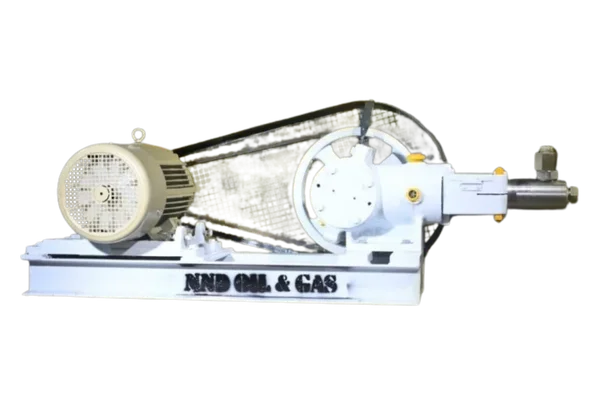
NND Oil & Gas’s liquid CO₂ transfer pump can be reviewed against the source conditions, connecting arrangement and required delivery duty.
Establish the Required Flow Rate
Define minimum, normal and maximum flow rather than providing one headline figure.
For a transfer application, consider the quantity to move and the available operating time. For filling, assess the complete cycle rather than assuming the pump delivers its rated flow throughout every stage.
Clarify whether the capacity requirement is expressed as:
- Litres per hour.
- Kilograms per hour.
- Quantity per batch.
- Number of containers filled within a defined period.
Converting between mass flow and volumetric flow requires an appropriate liquid density at the relevant conditions.
If a small pump is required, specify both the operating capacity and the available installation space. Low flow and compact dimensions are separate selection requirements.
Match Flow to Discharge Pressure
Review the required delivery rate at the actual discharge conditions.
Include the receiving pressure and losses through the discharge piping, valves and associated equipment. Where receiving pressure changes during operation, provide the expected range.
NND Oil & Gas publishes the following model information:
|
Model |
Published flow capacity |
Published discharge pressure |
| HTLC-1 | Up to 500 LPH | 80 kg/cm² |
| HTLC-2 | 750 LPH | 80 kg/cm² |
| HTTLC-0 | 1,500 LPH | 175 kg/cm² |
These figures provide a starting point for discussion. Confirm the selected model’s performance basis, inlet requirements and operating limits before ordering.
A discharge-pressure rating alone does not establish suitability for the complete filling or transfer cycle.
Specify How Filling Will Be Controlled
A pump moves and pressurises liquid. It does not, by itself, establish the correct filling quantity.
For cylinder filling, identify the required filling method, measurement equipment and stopping arrangements. Pressure alone should not be treated as confirmation that the correct quantity has been transferred.
The system review should establish:
- How the transferred quantity is measured.
- How completion is detected.
- What stops the pump or closes the filling route.
- How abnormal conditions are identified.
- Which controls and instruments are included in the supply.
Filling limits and procedures must follow the applicable container requirements and approved site arrangements.
Confirm Materials, Seals and Cleanliness Requirements
The complete wetted construction must suit the CO₂ service and temperature range.
Review seals, valves, connections and other components alongside the pump body. Identify any requirements relating to cleanliness, contamination control or documentation.
Food and pharmaceutical applications need their own specification. Suitability for general industrial transfer does not automatically establish compliance with those project requirements.
Likewise, liquid CO₂ service does not confirm suitability for supercritical CO₂ or hydrogen. Those duties require a separate assessment.
Include Controls and Pressure Protection
Selection should cover the wider installation, not only the pump.
Agree the required monitoring, shutdown and pressure-protection arrangements with the responsible engineer. The design should address relevant operating and failure conditions, including any sections where liquid can become trapped.
Confirm the destination of relief or vented CO₂ as part of the system design. These arrangements must suit the installation and should not be improvised during commissioning.
The quotation should identify the included instruments, valves, controls and associated equipment clearly.
Plan Access for Inspection and Maintenance
Allow space for inspection, isolation and replacement of service components.
Ask for the recommended maintenance requirements, spare-parts information and model-specific operating instructions. Also confirm what commissioning support and performance documentation will be provided.
For an existing installation, share drawings and details of previous operating problems. This can help identify system constraints before a replacement pump is proposed.
Select Around the Complete Operating Duty
A suitable selection brings together inlet conditions, required capacity, discharge pressure and practical operating requirements.
Define the source and receiving arrangements first. Then confirm the proposed pump’s performance, controls and supply scope against that duty. Planning a transfer or filling installation? Contact NND Oil & Gas with your inlet pressure, liquid temperature, required capacity and receiving-pressure details to discuss a suitable model.
Frequently Asked Questions
Can a higher discharge pressure prevent inlet vapour formation?
Not by itself. The inlet must meet the selected pump’s pressure and temperature requirements. A high discharge rating does not correct unsuitable supply conditions.
Can the same pump perform transfer and cylinder-filling duties?
Possibly, where its performance and operating limits suit both applications. The controls, measurement equipment and receiving arrangements also need review.
Does a liquid CO₂ rating cover supercritical service?
No. Suitability must be confirmed for the actual phase, pressure, temperature and complete equipment configuration.