Natural gas extracted from underground reservoirs contains water vapor. Before the gas can be transported through pipelines or sent to certain downstream processing operations, its moisture content often needs to be reduced to a specified level.
This process is known as gas dehydration. It is an important part of natural gas processing because excess moisture can contribute to hydrate formation, internal corrosion under certain conditions, and operational problems in pipelines and equipment.
Understanding how gas dehydration works, which methods are used, and what factors influence the process helps explain its role in maintaining gas quality and reliable operations.
What is Gas Dehydration?
Gas dehydration removes water vapor from natural gas to meet a moisture limit. This limit may be expressed as water content or as a water dew point, the temperature at which water starts to condense at a specified pressure.
Natural gas can hold water in its vapor phase. When pressure and temperature conditions change, some of this water may condense into liquid. If the gas contains sufficient water and reaches suitable low-temperature and high-pressure conditions, gas hydrates may also form. Gas dehydration reduces the amount of water available to condense or form hydrates during transportation and processing.
It is important to distinguish dehydration from ordinary gas-liquid separation. A separator or scrubber removes free liquid droplets from a gas stream, while a dehydration system removes water vapor. Both operations may be used in sequence.
Why is Gas Dehydration Important?
Removing excess water from natural gas supports pipeline operation and downstream processing in several ways.
Reduces the Risk of Hydrate Formation
Gas hydrates are ice-like crystalline solids formed when water molecules combine with natural gas components under suitable pressure and temperature conditions. These solids can accumulate inside pipelines, valves, instruments, and process equipment. Significant accumulation may restrict or block gas flow.
Reducing the water content of natural gas helps lower the risk of hydrate formation, particularly in systems exposed to low temperatures and high pressures.
Helps Control Internal Corrosion
Water alone does not cause every form of pipeline corrosion. However, when free water is present alongside acidic components such as carbon dioxide (CO₂) or hydrogen sulphide (H₂S), corrosive conditions can develop.
These conditions can contribute to internal corrosion of carbon steel pipelines and equipment. Gas dehydration reduces the water available to form a liquid phase, helping control one of the conditions associated with this type of corrosion. Other corrosion-control measures may still be necessary depending on the gas composition and operating environment.
Supports Pipeline Transportation
Pipeline operators generally specify limits for water content or water dew point in transported gas. If gas contains excess moisture, water may condense when the gas cools during transportation. This can create operating problems and increase the risk of hydrate formation. Dehydration helps bring the gas within the required moisture specification before it enters the relevant transportation system.
Protects Downstream Processing Operations
Some downstream processes require gas with a controlled moisture content. Excess water can affect process conditions, contribute to unwanted liquid formation, and create difficulties in equipment designed for specific gas-quality requirements.
The required dehydration level therefore depends on where the gas will be used next, such as pipeline transportation, low-temperature gas processing, or other treatment operations.
How Does Gas Dehydration Work?
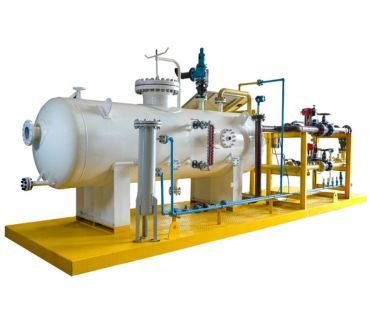
Several technologies can remove water from natural gas. One of the most widely used methods is glycol-based dehydration, particularly systems using triethylene glycol (TEG). A typical TEG dehydration process works through the following stages.
Inlet Gas Separation
In a typical glycol dehydration system, an inlet separator or knockout drum can remove water and hydrocarbon liquids already present as droplets. The gas then enters the glycol contactor, where water vapour is removed.
Contacting Wet Gas with Lean Glycol
The contactor is also called an absorber. Lean glycol, which has a relatively low water content, flows down through the vessel while wet gas flows up. As the two streams meet, the glycol absorbs water vapor. The treated gas leaves at the top, and the glycol carrying absorbed water, known as rich glycol, leaves at the bottom.
Regenerating the Rich Glycol
The rich glycol cannot continue absorbing water indefinitely. It must be regenerated before being reused. In a typical system, the rich glycol passes through equipment such as a flash tank and heat exchangers before reaching the regeneration section. It is then heated in a reboiler. The heating process separates absorbed water from the glycol, producing regenerated or lean glycol.
Cooling and Recirculating the Glycol
The regenerated glycol is cooled and circulated back to the contactor. This creates a continuous cycle in which glycol repeatedly absorbs water from incoming natural gas and is regenerated for reuse. The required glycol concentration and operating conditions depend on the water-removal duty and the outlet gas specification.
What Are the Main Methods of Gas Dehydration?
Glycol absorption is not the only method used to remove water from natural gas. The appropriate technology depends on the required outlet moisture level, process conditions, and downstream application.
| Dehydration method | How it works | Common application |
| Glycol absorption | A liquid desiccant, commonly TEG, absorbs water vapour from gas | Pipeline gas and general gas processing |
| Solid desiccant adsorption | Water molecules are retained on the surface or within the pores of a solid desiccant | Applications requiring very low moisture content |
| Refrigeration and condensation | Gas is cooled so that water vapour condenses and can be separated as liquid | Applications where cooling and liquid separation are part of the process |
Molecular sieves, silica gel, and activated alumina are examples of solid desiccants used in adsorption systems.
These methods should not be treated as interchangeable. For example, solid desiccant systems may be selected when a particularly low outlet water content is required, while glycol systems are commonly used for many conventional gas dehydration duties.
NND’s gas meter skids integrate gas metering equipment with supporting piping, valves, and instrumentation for project-specific gas measurement requirements.
What Factors Influence Gas Dehydration System Selection?
Selecting a dehydration method requires an understanding of the incoming gas and the required treated-gas conditions.
Important considerations include:
- Inlet gas moisture content: The amount of water entering the system influences the required water-removal duty.
- Gas flow rate: The system must accommodate the expected gas throughput.
- Operating pressure and temperature: These conditions influence water content, dew point, and process behavior.
- Required outlet specification: Pipeline requirements or downstream process conditions determine how much water must be removed.
- Gas composition: Components such as CO₂, H₂S, and heavier hydrocarbons may influence equipment selection and operating considerations.
- Operating and maintenance requirements: Energy use, desiccant or glycol handling, regeneration requirements, and maintenance needs should be evaluated.
The final design should be based on process calculations and the applicable project specifications rather than a general rule applied to every gas stream.
Equipment and Temperature Considerations Around Gas Processing
Dehydration is one part of a wider natural gas processing system. Other equipment may be required before and after dehydration to support separation, heating, measurement, and transportation.
For example, gas temperature may need to be controlled in certain pressure-reduction and processing applications. An indirect water bath heater is used to heat natural gas and other process fluids through an intermediate heating bath. It is a temperature-conditioning device, not a gas dehydration unit.
After gas treatment, flow measurement may also be required for process monitoring, distribution, or custody-transfer applications. These systems perform different functions within the wider gas processing and transportation network.
Conclusion
Gas dehydration is an important operation in natural gas processing because it reduces water vapour before gas enters pipelines or downstream equipment.
By controlling moisture, dehydration helps reduce the risk of hydrate formation, supports pipeline moisture specifications, and limits conditions associated with internal corrosion. Glycol absorption using TEG is a widely used method, while solid desiccant adsorption and refrigeration-based approaches are selected for other process requirements.
The appropriate method depends on gas composition, operating conditions, required outlet moisture content, and the needs of downstream operations. Understanding these factors is essential when evaluating a natural gas dehydration system.
Frequently Asked Questions
What is the most commonly used method of natural gas dehydration?
Glycol absorption using triethylene glycol (TEG) is one of the most widely used methods for conventional natural gas dehydration.
Does gas dehydration remove all water from natural gas?
No. Dehydration reduces the water content to a specified level. The required outlet moisture content depends on pipeline requirements and downstream process conditions.
What is the difference between gas dehydration and hydrate inhibition?
Gas dehydration removes water vapour from natural gas. Hydrate inhibition involves adding chemicals, such as methanol or monoethylene glycol, to reduce the temperature at which hydrates form. They are different approaches to managing hydrate risk.