Injection quills are used in industrial piping systems to introduce chemicals directly into a flowing process stream. They are commonly used for injecting corrosion inhibitors, scale inhibitors, biocides, and other treatment chemicals in oil and gas, water treatment, and chemical processing applications.
One important consideration in selecting an injection quill is its material of construction. The material must be compatible with the injected chemical and surrounding process fluid while meeting the operating temperature and pressure requirements.
Start by comparing the conditions inside and outside the quill. For example, the quill bore may carry a corrosion inhibitor while the outside of the probe is exposed to a hot, chloride-containing process stream. The selected material must be suitable for both exposures.
Why is Material Selection Important for Injection Quills?
An injection quill is exposed to two different environments: the injected chemical inside the quill and the process fluid surrounding its external surface.
Both environments can influence material performance. The wrong material selection may result in corrosion, chemical degradation, leakage, or premature replacement.
NND Oil & Gas offers fixed and retractable chemical injection quills. Confirm the quill configuration and materials of construction together when specifying the assembly.
Key Factors to Consider When Selecting Injection Quill Materials
Chemical Composition and Concentration
The chemical being injected is one of the first things to consider. Acids, alkalis, solvents, oxidizing chemicals, and chloride-containing solutions can affect materials differently.
Concentration also matters. Check compatibility across the expected concentration range, including any dilution during preparation or flushing. For some chemicals, corrosion can be more severe at intermediate concentrations.
Engineers should review the chemical name, formulation, concentration, impurities, and relevant compatibility data before finalizing the material.
Operating Temperature
Temperature can influence corrosion rates, chemical reactions, and material properties.
Some materials that perform well at lower temperatures may have limitations under elevated-temperature conditions. Chemical compatibility should therefore be evaluated at the actual operating and maximum design temperatures.
Operating Pressure
Injection quills are installed in pressurized piping systems. Their material and construction must meet the mechanical requirements of the application.
Selection should account for design pressure, wall thickness, connection arrangement, and applicable piping or equipment design requirements.
Process Fluid and Environmental Conditions
The fluid surrounding the quill also affects material selection. Factors such as chloride content, pH, hydrogen sulphide (H₂S), carbon dioxide (CO₂), moisture, and flow conditions may influence corrosion behavior.
For example, chloride-containing environments can contribute to pitting corrosion and, under certain temperature and stress conditions, stress corrosion cracking in susceptible stainless steels.
Common Materials Used for Injection Quills
Different material families are considered depending on the chemical environment and operating conditions.
| Material | General characteristics | Key consideration |
| Carbon Steel | Common structural and piping material | Corrosion exposure |
| Stainless Steel 316/316L | Corrosion resistance in many environments | Chloride concentration and temperature |
| Duplex Stainless Steel | High strength and resistance to certain corrosion mechanisms | Grade and service conditions |
| Nickel-Based Alloys | Available in grades for aggressive environments | Exact chemical compatibility |
| Titanium | Strong corrosion resistance in selected environments | Chemical and temperature compatibility |
| PTFE / Polypropylene | Chemical-resistant polymer options | Temperature, pressure, and mechanical limits |
No single material is suitable for every application. The specific grade and service conditions must be evaluated before selection.
Material Selection for Corrosive and High-Temperature Applications
Different chemical environments create different material challenges. The following examples illustrate why selection should be application-specific.
Acidic Chemical Applications
Acids such as hydrochloric acid and sulfuric acid have different corrosion characteristics. Their effects depend on concentration, temperature, impurities, and exposure conditions.
A material suitable for one acid may not be suitable for another. Compatibility data should be checked for the exact chemical formulation and operating conditions.
Chloride-Containing Applications
Chlorides can contribute to pitting and crevice corrosion in susceptible stainless steels. Under certain conditions, they may also contribute to chloride stress corrosion cracking.
Duplex stainless steels and selected higher-alloy materials may be considered depending on chloride concentration, temperature, and other service conditions.
High-Temperature Chemical Applications
High-temperature service requires evaluation of both corrosion resistance and mechanical properties.
Some polymers and linings have temperature limitations, while metals may experience changes in strength or corrosion behavior at elevated temperatures.
Check the temperature limits of the lining and seals, where fitted, alongside the metallic components. Confirm the pressure rating of the assembled quill at the design temperature.
Practical Considerations Before Finalizing Material Selection
A structured evaluation helps engineers compare material options and identify potential compatibility issues.
- Identify the chemicals: Record the injected chemical, process fluid, concentration, and impurities.
- Define operating conditions: Establish normal and maximum design temperature and pressure.
- Check material compatibility: Review reliable compatibility data for the exact material grade.
- Evaluate corrosion mechanisms: Consider general corrosion, pitting, crevice corrosion, and stress corrosion cracking where relevant.
- Verify mechanical requirements: Check pressure rating, strength, dimensions, and connections.
- Review fabrication requirements: Consider welding, joining methods, and inspection requirements.
- Consider maintenance conditions: Include cleaning, flushing, startup, and shutdown requirements.
How Does the Injection System Affect Material Selection?
Material selection should also consider the complete chemical injection arrangement, not just the quill probe.
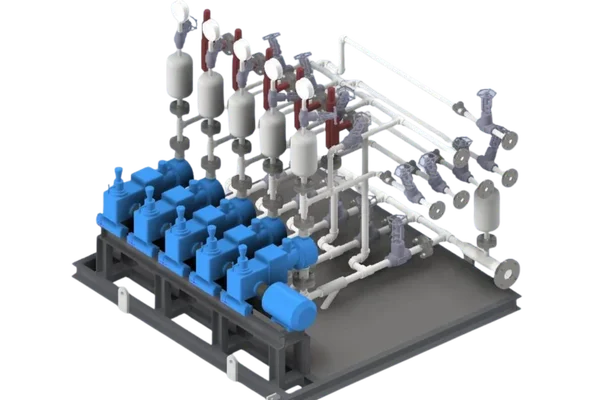
The dosing pump supplies the required chemical flow, while the quill provides the injection point into the process pipeline. The pump, connecting tubing, valves, fittings, seals, and quill may all come into contact with the chemical.
Each wetted component requires suitable material compatibility. For more information about the equipment used to supply chemicals into industrial processes, refer to the chemical dosing system page.
Conclusion
Selecting an injection quill material requires consideration of chemical composition, concentration, operating temperature, pressure, and the surrounding process environment.
Materials such as stainless steel, duplex stainless steel, nickel-based alloys, titanium, and polymer-lined options may be suitable for different applications. However, their suitability depends on the exact grade and service conditions.
A systematic material evaluation helps identify potential compatibility issues and supports appropriate material selection for corrosive and high-temperature chemical injection applications.
Frequently Asked Questions
Is stainless steel 316 suitable for all chemical injection applications?
No. Its suitability depends on the chemical, concentration, temperature, and operating environment.
Why should cleaning and flushing fluids be included in the compatibility check?
They can expose the quill to a different chemical or concentration from the normal dosing fluid. Include the cleaning and flushing conditions when checking the quill material, lining and seals.
Can a chemical compatibility chart determine the final material?
It can help with initial screening, but final selection should also consider concentration, temperature, pressure, and operating conditions.