In oil and gas processing, gas streams can contain liquid droplets, accumulated liquids, or occasional liquid slugs. These liquids may need to be removed before the gas moves to downstream equipment or another stage of processing.
Two commonly used types of equipment for gas-liquid separation are separators and knockout drums. Although the terms are sometimes used interchangeably, they can refer to different process duties and equipment arrangements.
Understanding the difference helps engineers evaluate which equipment is appropriate for a particular application. The selection depends on the incoming fluid, liquid loading, required separation performance, operating conditions, and downstream requirements.
What is a Gas-Liquid Separator?
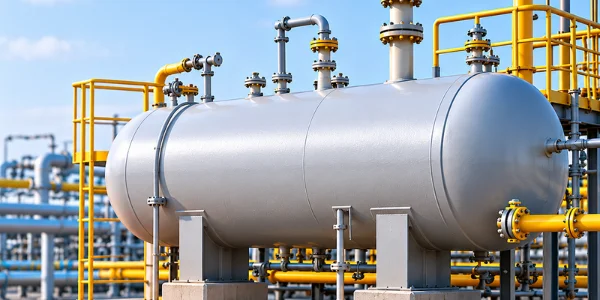
A gas-liquid separator is a vessel designed to separate gas from liquid in a process stream. Depending on its configuration, it may separate free liquid from gas or divide a well stream into gas, oil, and water phases.
Separation generally occurs through differences in phase density. When the incoming fluid enters the vessel, its velocity and flow pattern change. Liquid droplets can separate from the gas and collect in the liquid section, while gas moves towards the gas outlet.
Depending on the process requirements, a separator may include components such as:
- Inlet diverter to change the incoming flow direction and reduce momentum.
- Gravity separation section to allow liquid droplets to settle.
- Mist eliminator to capture smaller droplets from the gas stream, where required.
- Liquid collection section.
- Gas and liquid outlet connections.
- Level and pressure instrumentation.
The configuration depends on the number of phases being separated and the required process duty.
What is a Knockout Drum?
A knockout drum is a vessel used to remove free liquid and entrained liquid droplets from a gas stream. It is commonly associated with applications where liquid removal is required before gas enters downstream equipment or a disposal system.
Its basic separation principle involves reducing gas velocity inside the vessel. This allows larger liquid droplets to separate under gravity and collect in the liquid section.
A knockout drum may contain:
- Inlet section.
- Gas outlet.
- Liquid collection section.
- Liquid drain or outlet.
- Level control arrangement.
- Mist eliminator, where required.
The internal arrangement depends on the liquid loading, gas flow conditions, and required separation performance.
Knockout drums are used in applications such as compressor suction systems, flare systems, fuel gas lines, and gas processing facilities.
Separator vs Knockout Drum: Key Differences
The main distinction is the intended process duty rather than simply the equipment name. A knockout drum is itself a form of gas-liquid separation vessel, but the term often describes equipment selected for a particular liquid-removal service.
| Comparison Factor | Production Separator | Knockout Drum |
| Main purpose | Separates gas and liquid phases | Removes liquid from gas streams |
| Process duty | General gas-liquid or multiphase separation | Liquid removal from gas |
| Liquid handling | Depends on the separation process | Depends on expected liquid loading and accumulation |
| Internal arrangement | May include different separation internals | Internal components depend on the amount of liquid the drum must remove and the size of the droplets it needs to capture. |
| Typical applications | Production and processing systems | Compressor protection, flare, and gas systems |
| Design basis | Phase separation requirements | Gas flow, liquid loading, and required liquid removal |
These are general descriptions, not fixed design rules. Actual configurations can overlap, and the project specification should define the required separation duty.
When Should You Choose a Separator?
A gas-liquid separator is generally considered when the process requires separation of produced fluids or gas-liquid streams as part of a production or processing operation.
For example, a production stream from an oil well may contain gas, oil, and water. A three-phase separator is used when all three phases need to be separated within the vessel.
A separator may be appropriate when:
- The incoming stream contains multiple phases that need to be separated.
- Liquid separation is part of the main production or processing operation.
- The process requires defined gas, oil, or water outlet streams.
- The required separation performance calls for specific internal components.
- The vessel must accommodate the expected gas and liquid flow rates.
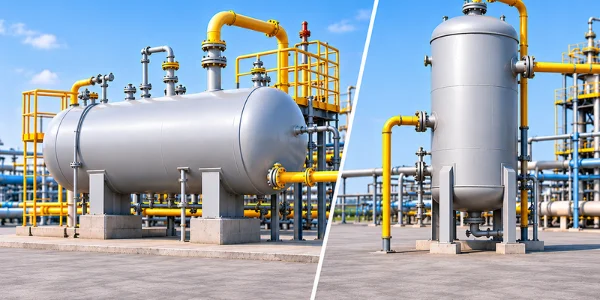
The selection also involves deciding between horizontal and vertical arrangements.
When Should You Choose a Knockout Drum?
A knockout drum is considered when the primary requirement is to remove liquid from a gas stream before it reaches downstream equipment or a disposal system.
For example, gas entering a compressor may contain entrained liquid droplets. A knockout drum installed upstream can collect separated liquid before the gas reaches the compressor.
Common applications include:
- Compressor suction systems: Removing liquid from gas before it enters the compressor.
- Flare systems: Collecting liquid carried through relief and flare headers before gas reaches the flare system.
- Fuel gas systems: Removing liquid from gas streams before downstream fuel gas equipment.
- Gas pipelines: Collecting free liquid at designated points in the gas handling system.
- Gas processing facilities: Removing liquid from gas streams at selected process stages.
The required vessel size and internal arrangement depend on gas flow rate, liquid loading, expected liquid accumulation, operating pressure, and the required droplet removal.
A knockout drum is therefore evaluated according to the specific gas stream and liquid-removal duty rather than its name alone.
Important Factors When Selecting Between Them
The equipment selection should begin with the process requirements. The following factors help establish the appropriate configuration.
Phase Composition
Determine whether the incoming stream contains gas and one liquid phase or gas, oil, and water.
If the process requires separate gas, oil, and water outlets, a suitable multiphase separator arrangement is needed. If the main requirement is removing liquid from gas, a knockout drum may be appropriate.
Gas Flow Rate and Liquid Loading
Both gas flow and liquid loading influence vessel sizing.
The gas flow rate affects the available gas-handling area and gas velocity. Liquid loading determines the required liquid collection and handling capacity.
Expected operating conditions and possible liquid surges should also be considered.
Required Separation Performance
The required outlet gas quality influences the internal arrangement.
For example, an application requiring removal of smaller liquid droplets may need an appropriate mist elimination arrangement. The selection of internals must account for the fluid properties and operating conditions.
Operating Pressure and Temperature
Operating pressure and temperature affect gas and liquid properties, including density and flow behavior.
These properties influence the separation calculations and the selection of vessel dimensions and materials.
Installation and Maintenance Requirements
Available installation space, access for inspection, drainage arrangements, and maintenance requirements should also be evaluated.
Horizontal and vertical vessels have different space arrangements. The final choice should consider the available installation area and the process duty.
Where internal corrosion is a concern, corrosion coupons can be used to monitor corrosion rates in process vessels and pipeline systems.
Can a Knockout Drum Be Used Instead of a Separator?
A knockout drum can perform a gas-liquid separation duty, but it should not automatically be treated as a replacement for every type of separator. The decision depends on what the process needs to achieve.
For example, a simple liquid-removal duty in a gas line may be suitable for a knockout drum. However, a production process requiring separate gas, oil, and water streams needs a separator designed for that duty.
In some systems, both types of equipment may be used at different process stages. One vessel may perform the primary separation, while another removes remaining liquid before a particular downstream unit. The process flow diagram, fluid composition, design conditions, and required outlet specifications should guide this decision.
Conclusion
Separators and knockout drums both perform gas-liquid separation, but their intended process duties can differ. A gas-liquid separator is a broader equipment category that may handle gas-liquid or multiphase separation. A knockout drum is commonly selected for removing liquid from gas streams, particularly where downstream equipment or disposal systems require liquid removal.
The correct choice depends on phase composition, gas flow rate, liquid loading, separation requirements, operating conditions, and installation constraints. Evaluating these factors provides a sound basis for selecting the appropriate vessel and configuration.
Frequently Asked Questions
Is a knockout drum considered a separator?
Yes. A knockout drum is a type of gas-liquid separation vessel, generally used to remove liquid from a gas stream.
Can a knockout drum remove fine liquid droplets?
It can, depending on its design and internal arrangement. Where finer droplet removal is required, an appropriate mist elimination device may be considered.
What information is needed to select a separator or knockout drum?
Important inputs include gas and liquid flow rates, fluid composition, operating pressure and temperature, liquid loading, and required outlet conditions.