A pump setting tells you how the equipment has been adjusted. It does not, on its own, confirm how much chemical reaches the process.
Calibration connects the setting to measured delivery under defined conditions. That information helps establish the required dose and investigate changes in performance.
The method depends on the pump, chemical and installed equipment. This guide covers what to check when planning calibration, rather than a universal valve-operating procedure.
Adjustment and Calibration Serve Different Purposes
Adjustment changes the pump’s intended delivery.
Depending on the design, this might involve stroke length, cycle frequency, operating time or another control.
Calibration measures the resulting output using an appropriate reference method. Comparing the result with the required flow shows whether further adjustment is needed.
An adjustable metering pump therefore needs more than a readable scale. Its setting should be checked against actual performance at the relevant duty.
Establish the Required Flow First
Confirm the target dose before changing the pump.
The required flow may come from a treatment specification, process calculation or approved control strategy. Ensure everyone is using the same units.
Common sources of confusion include:
- Litres per hour versus litres per day.
- Millilitres versus litres.
- Chemical solution volume versus active chemical quantity.
- Continuous operation versus timed injection.
- Different chemical concentrations.
A correctly calibrated pump can still deliver the wrong treatment quantity if the target itself has been calculated incorrectly.
Changes to treatment concentration should be reviewed by the responsible process or treatment specialist.
Identify the Model’s Adjustment Method
Do not assume every pump uses the same control.
A micrometre adjustment, electronic timer and air regulator can have different functions. Their relationship to output depends on the equipment design.
Consult the model-specific instructions to establish:
- Which control changes delivered quantity.
- Whether adjustment is permitted during operation.
- The approved operating range.
- Any minimum setting requirements.
- The correct sequence for verifying a new setting.
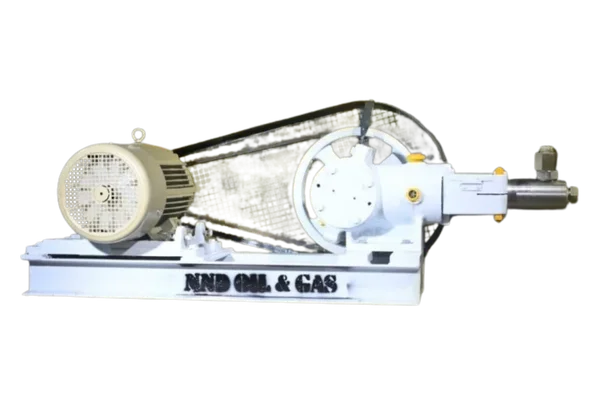
NND Oil & Gas’s air/gas operated metering pump page identifies its adjustment and calibration features. Confirm the supplied model’s instructions before carrying out site adjustments.
Confirm the Measurement Arrangement
Calibration requires a suitable way to determine delivered quantity over a measured period.
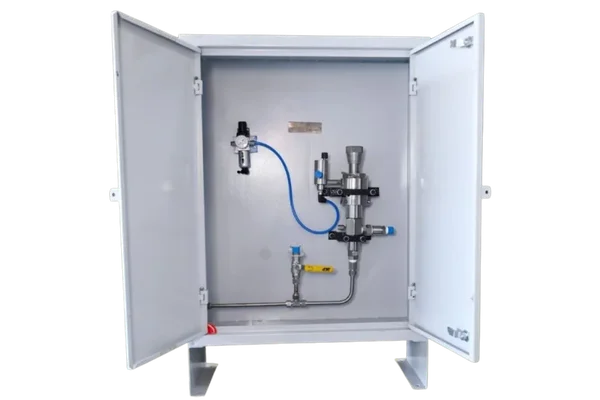
Depending on the installation, an approved method may use a calibration column, a suitable flow instrument or a mass-based measurement arrangement.
The equipment must suit the chemical and provide adequate resolution at the expected flow.
| Check | Why it matters |
| Measuring range | Very small changes may be difficult to read on oversized equipment |
| Chemical compatibility | Wetted materials must suit the liquid |
| Instrument condition | Damage, fouling or sticking can distort readings |
| Timing | Flow calculation depends on the measured duration |
| Installation | Connections and flow paths must follow the approved design |
| Fluid condition | Gas bubbles or unstable supply can affect the result |
A calibration-column drawdown measures liquid leaving the column. Before treating that as delivered injection flow, confirm that unintended leakage or diversion is not affecting the measurement.
Keep Operating Conditions Relevant
Calibration is most useful when it reflects the conditions under which the pump will operate.
Record the discharge pressure, supply conditions and relevant fluid properties. For pneumatic equipment, include the air or gas supply settings.
If the test uses different conditions from normal operation, establish how those differences affect the result.
For example, testing against an open discharge may not represent injection into a pressurised process. The approved method should address this distinction.
Do not disconnect or redirect a chemical discharge simply to make measurement easier without an authorised arrangement.
Calculate Flow Using Consistent Units
Where an approved method measures volume over time:
Flow rate = measured volume ÷ elapsed time
For example, if the measured quantity is 100 mL over five minutes:
- 100 mL equals 0.1 litres.
- Five minutes equals 1/12 of an hour.
- The calculated flow is 1.2 litres per hour.
This illustrates the arithmetic only. The suitable test duration and measuring range depend on the equipment and required accuracy.
For a mass-based method, conversion to volumetric flow also requires an appropriate fluid density.
Check Repeatability Before Accepting the Result
A single measurement provides limited evidence.
Repeat the check according to the approved procedure and compare the readings. If results vary substantially, investigate the reason before making repeated control changes.
Potential issues include:
- Inconsistent pneumatic supply.
- Incomplete pump filling.
- Gas in the liquid end.
- Check-valve contamination or wear.
- Changes in discharge conditions.
- An unsuitable or incorrectly used measuring device.
Increasing the setting may conceal an underlying problem temporarily without resolving it.
Record the Setting and Test Conditions
A useful calibration record should allow another person to understand and repeat the check.
Include:
- Pump identification.
- Chemical and concentration.
- Date and operator.
- Target flow.
- Adjustment settings.
- Measured quantity and duration.
- Calculated output.
- Relevant operating conditions.
- Any corrective action.
Where performance across several settings is important, establish an approved calibration record covering those operating points. Avoid assuming the response between settings is perfectly linear.
When Should Calibration Be Reviewed?
The appropriate frequency depends on the application and site requirements.
A review may be warranted after commissioning, relevant maintenance, a chemical change or an unexplained change in treatment performance.
Changes to the wider chemical dosing system may also affect delivery. Consider alterations to suction piping, injection components and operating pressure when deciding whether another check is required.
Use Measured Output to Guide Adjustment
Reliable dosing requires a clear target, an appropriate measurement method and a repeatable result.
Keep calibration conditions relevant to the operating duty and record enough detail to support future checks. Need support reviewing pump adjustment or calibration equipment? Contact NND Oil & Gas with your pump model, target flow and current operating conditions.
Frequently Asked Questions
Does a 50% setting always deliver half the maximum flow?
No. That relationship must be established for the pump and operating conditions. Do not assume it from the scale alone.
Can a pressure gauge confirm dosing flow?
No. A pressure reading does not establish delivered volume. Flow needs an appropriate measurement method.
Should unstable output be corrected by increasing the setting?
Investigate the instability first. Supply problems, gas, worn components or measurement issues can all require attention.