Collecting liquid from a process line can involve more than placing a container beneath an outlet. The fluid may be hot, pressurised, volatile or sensitive to contact with the atmosphere.
These characteristics influence whether an open collection method is appropriate or a more contained arrangement is needed.
Understanding the difference between open and closed sampling helps you prepare a clearer equipment specification. It also prevents assumptions about what a particular system can contain or preserve.
What Is Open Sampling?
In open sampling, the liquid is exposed to the surrounding atmosphere during collection.
A typical example is filling an open container from a sampling outlet. The equipment and procedure still need to control the release, but the collection interface does not fully contain the liquid and its vapour.
Whether this approach is suitable depends on the fluid, operating conditions, exposure assessment and analytical requirements.
An arrangement acceptable for one water-based process may be unsuitable for a volatile hydrocarbon or aggressive chemical.
What Is Closed Sampling?
Closed sampling uses an enclosed collection arrangement intended to limit contact between the process fluid, the operator and the surrounding environment.
The design may use a sealed bottle interface or a pressure-containing receiver. These configurations serve different purposes and should not be treated as interchangeable.
A sealed interface does not automatically make an ordinary laboratory bottle capable of holding process pressure. The complete system must manage pressure and displaced fluid or vapour appropriately.
Closed sampling also does not automatically mean zero emissions. Performance depends on the valves, connections, vent handling and operating method.
Closed Sampling and Closed-Loop Sampling Are Different
These terms are sometimes used as though they mean the same thing.
A closed collection arrangement contains the sample during transfer. A closed-loop design also provides a circulation or return path as part of its configuration.
The destination and driving conditions for that return flow must be engineered. A system should not be described as closed-loop simply because the receiver has a lid or sealed connection.
When discussing equipment, ask the supplier to identify:
- The process inlet.
- The collection route.
- Any return connection.
- Vent, drain or recovery destinations.
- How the receiver is connected and removed.
A drawing often communicates more clearly than the label “closed system”.
Open vs Closed Sampling at a Glance
| Selection factor | Open collection | Closed collection |
| Atmospheric contact | Present during collection | Reduced through a contained interface |
| Operator contact | Greater potential for direct exposure | Designed to limit exposure |
| Volatile components | Atmospheric release may change the sample | Suitable containment may help preserve composition |
| Equipment arrangement | May involve fewer components | May require additional valves and receiver interfaces |
| Pressure handling | Requires controlled delivery to the collection point | Depends on the complete design and receiver rating |
| Maintenance | Outlet and flow path need attention | Seals, connectors and containment components also need inspection |
Neither column establishes suitability by itself. The application determines which arrangement is appropriate.
Start with the Fluid’s Behaviour
Before comparing equipment, identify how the liquid behaves during collection.
A fluid that remains stable at atmospheric conditions presents different requirements from one that releases dissolved gas or loses lighter components when pressure falls.
Include the following in the specification:
- Chemical identity and composition.
- Relevant hazards.
- Vapour pressure or volatility information.
- Operating pressure and temperature.
- Corrosive or reactive properties.
- Presence of solids or multiple phases.
The sampling method must also protect the properties needed for laboratory analysis. Containing a liquid safely and collecting an analytically suitable sample are related requirements, but both need explicit review.
Match the Receiver to the Collection Method
A bottle may suit a liquid that can be collected and stored at atmospheric pressure without compromising the intended test.
Other applications may require a pressure-containing cylinder to retain the sample in a suitable condition.
The container connection, pressure management and sampling valves must work together. Selecting a receiver independently of the sampling assembly can create compatibility or handling problems.
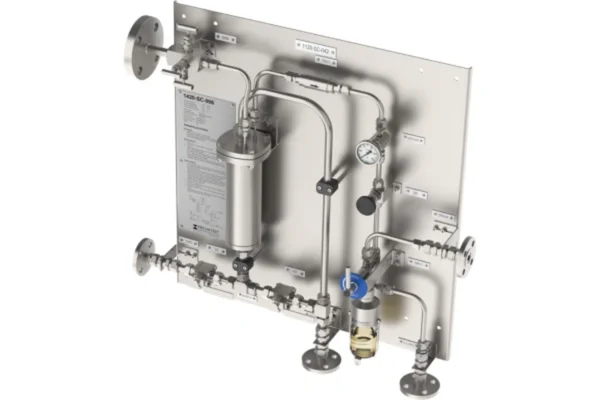
NND Oil & Gas offers process liquid sampling equipment with application-specific valves, connections and receiver arrangements. The proposed configuration should be confirmed against the actual duty.
Consider Routine Use and Maintenance
A contained arrangement needs to remain practical for the people using it.
Review access to valves, the space needed to connect a receiver and the ability to inspect seals and fittings. The design should also account for the required sampling frequency.
Useful questions include:
- Can the operator identify each control clearly?
- Is the receiver adequately supported?
- Are connection points accessible?
- Can maintenance be carried out with suitable isolation?
- Are replacement seals and fittings available?
- Does the documented procedure match the installed assembly?
Maintenance planning should cover the whole collection path, including vent or recovery components where fitted.
Information to Provide When Requesting Equipment
| Requirement |
Information to share |
| Sampling purpose | Required laboratory tests and quality checks |
| Process conditions | Normal and design pressure and temperature |
| Fluid details | Composition, hazards and compatibility information |
| Receiver | Bottle, vessel or cylinder requirements |
| Installation | Connection details and available space |
| Operation | Sample volume and collection frequency |
| Containment | Exposure, vent handling and recovery requirements |
A clear enquiry makes it easier to assess the required arrangement without relying on broad product terminology.
Select the Arrangement Around the Application
The decision should follow the fluid’s behaviour, the required analysis and the site’s operating requirements.
Specify what needs to be contained, which sample properties must be preserved and how the equipment will be used and maintained. These details provide a stronger basis for selection than the terms open or closed alone.
Need help defining your collection requirements?Contact NND Oil & Gas to discuss your process fluid, operating conditions and preferred sample receiver.
Frequently Asked Questions
Is closed sampling always automatic?
No. Manual operation and containment are separate features. A manually operated arrangement can still use a closed collection interface.
Does a sealed bottle hold process pressure?
Not necessarily. A sealed closure does not establish a pressure rating. The bottle and sampling arrangement must be selected for their intended operating conditions.
Can an existing open sampling point be converted?
Possibly, but it requires an engineering review. Connections, isolation, pressure management, receiver compatibility and installation space all need assessment.